Committee for Humanitarian Intervention Platform BiH
Manifesto for peace and justice in Bosnia
Dutch efforts are urgently needed
May 2023
Developments in Bosnia are in a critical phase. The European Union (EU) has offered Bosnia EU membership. But at the same time ethnic extremism is on the rise and secession and violence are looming. The Netherlands can – in an international coalition – play a role in helping to turn things around for the better. The Netherlands also has a special responsibility in this: during the genocide in Srebrenica in July 1995, we saw what can happen when one let ethnic extremism run its course unchallenged. In this manifesto we call on the Netherlands to take on its responsibility for Bosnia.
Developments in Bosnia
The vast majority of Bosnians wants the country to develop democratically and to join the EU eventually. This became apparent during the elections in October 2022. Unfortunately they are being drowned out by extremist politicians. Especially leaders of Bosnian Serbs and Bosnian Croats are shouting for secession of ‘their’ peoples. Please note: this does not concern a peaceful secession, like how certain Scots wish to separate themselves from England. Rather it concerns the return to the ethnic extremism of the war (’92 – ’95), in which ‘other’ population groups were systematically expelled. At the start of this year Bosnian Serbs held a military parade in Sarajevo to mark the founding of the Bosnian-Serb entity ‘Srpska‘, the beginning of the war. At the end of April 2023, the Bosnian-Serb leader, Milorad Dodik, announced to guard the border of this entity. In ‘Srspka’ large murals of war criminals can be found. Bosnian-Croat leaders are organizing similar forms of intimidation.
These extremists are given space by Bosnia’s lopsided and lethargic state structure. This one is still based on the Dayton peace agreement of autumn 1995. This divides political power according to ethnic background. The resulting state structure is discriminatory because it excludes population groups such as Jews, Roma and Bosnians of mixed background from public positions. Nationalist politicians misuse this structure to strengthen their positions of power.
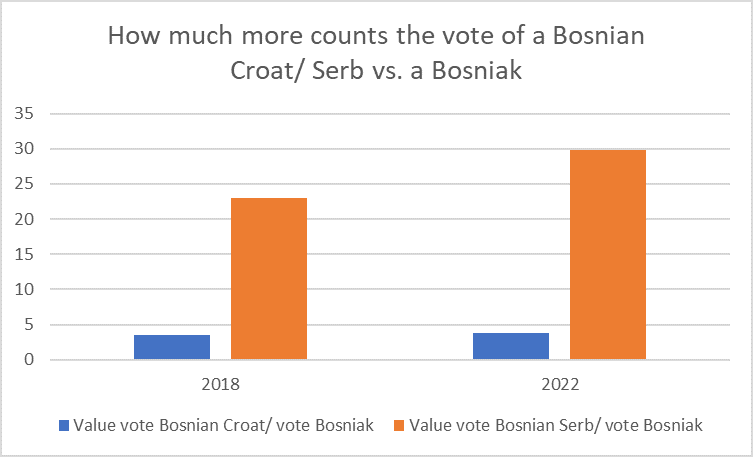
Under the Dayton Agreement, the international community also has installed the so-called ‘High Representative’. This High Representative can intervene against extremism. However the current High Representative, the German Christian Schmidt, does not. On the contrary: he turns out to be acting as the extension of one of the ethnic groups, the Bosnian Croats. On the very night (!) of the last elections he amended the electoral law, giving this group more voting rights: the vote of a single Bosnian Croat were to count for no less than four times more than that of a Bosniak. On April 27, 2023, Schmidt pushed through a new amendment to the constitution, which diminished the position of Bosniaks even further. Bosnia is therefore no longer a democracy; from now on the High Representative effectively determines what type of government will be created.
Position and influence of the Netherlands
The Netherlands can exert influence on the administration of Bosnia.
The Netherlands participates in the group of countries that bears ultimate responsibility for the actions of the High Representative. As indicated, the latter has far-reaching powers. Among other things, he/she can fire local politicians who call for violence or threaten with secession. It is urgent that the High Representative will finally use these powers. Christian Schmidt unfortunately follows a very different course however. He should be replaced by someone who is able to stand above the parties.
The Netherlands is an important member of the EU. There is an urgent need for the EU to impose sanctions against extremist politicians in Bosnia and halt financial support to their activities. This applies in particular to the Bosnian-Serb entity Srspka. At the same time, we are calling for sanctions on the neighboring countries Croatia and Serbia, as long as they support extremists in Bosnia.
The Netherlands participates in the EUFOR peacekeeping force. Recently it pledged 160 military personnel. We wholeheartedly support this step. Unfortunately, however, we observe that EUFOR fails to act against manifestations of extremism in Bosnia. We call on EUFOR to actively protect the citizens of Bosnia.
Structurally, Bosnia needs a new constitution. A constitution in which ethnicity plays no role, but in which every inhabitant, regardless of origin, has the same rights. As a first step on this road, we call on the Netherlands to test whether the Dayton treaty is actually legally valid at the International Court of Justice in The Hague.
What is needed? 1. We call on the High Representative to sack extremist politicians in Bosnia, and ensure that they don’t fulfill public functions. He can do this using his so-called Bonn-powers. 2. The EU must impose sanctions against extremist politicians in Bosnia and halt financial support to the Bosnian-Serb entity ‘Srpska’ in particular. 3. EU sanctions are also necessary against Croatia and Serbia as long as these countries continue to support ethnic extremism in Bosnia. Serbia can only access the EU if it fully respects the state of Bosnia. 4. Decisive action by the EUFOR force in the event of threats of intimidation or violence. 5. Replacement of Bosnia’s Dayton-based constitution by a truly democratic constitution based on ‘one man, one woman, one vote’. 6. Replacement of the current High Representative, Christian Schmidt, by someone who is impartial. His successor must rescind the alterations of the electoral law. |
Background:
- This Manifesto is drawn up by the Platform BiH and the Committee Humanitarian Intervention, both based in the Netherlands. Platform BiH is the umbrella organization of Bosnian associations in the Netherlands. It represents and promotes the interests of citizens from Bosnia and Herzegovina. The Committee for Humanitarian Intervention (CHI) consists of a group of citizens which is committed to help protect people in countries who are unable to defend themselves against violence. Its current focus is on Bosnia, Kosovo and Ukraine.
- Since the Bosnian war of ’92 – ’95, the country’s state structure is based on the peace treaty of Dayton, which ended that war. This treaty is very complex, with a role for individual ethnic groups. It is alas discriminatory: someone who happens to be a Jew or Roma cannot even become president. The same goes for someone who does not belong or wish to belong to one of the three main ethnic population groups (Bosniak, Serb, Croat), for example because his or her parents belong to different groups.
- Dayton promotes corruption and ethnic extremism. This is fueled by leaders like Milorad Dodik (leader of Bosnian Serbs) and Dragan Covic (leader of Bosnian Croats). On January 9, 2023, when the Bosnian Serbs held a military parade in Sarajevo, groups took part that had participated in the war 30 years ago. Also, the son of the Serbia’s president, Aleksandar Vucic, was present. Large murals of war criminal Ratko Mladic, convicted for the Srebrenica genocide, can be found in cities in the Bosnian-Serb entity ‘Srspka’.
- This entity, Republika Srpska, was originally created at the start of the war to create an ethnically pure Serbian area, free from other population groups. This led, among other things, to the genocide in Srebrenica. The Dayton Agreement gave this entity a formal status. There are strong indications that the Dayton Agreement for this fact alone does not comply with higher international law – and should thus be declared null and void.
- The leader of the Bosnian Serbs, Milorad Dodik, constantly undermines the Bosnian unitary state. He repeatedly calls for secession of ‘Srpska’ away from Bosnia, refuses to participate in state institutions and calls on Bosnian Croats to boycot these as well. He works closely with Serbian President Vucic and Russian President Putin. On April 24 this year he announced to establish guard patrols on the borders of Srpska, which actually amounts to the establishment of a military force. The High Representative’s reaction was lukewarm.
- Neighboring countries Croatia and Serbia play a bad role in all of this. They are inflaming nationalist fervor among Bosnian Serbs and Bosnian Croats. Russia is meddling too. Bosnian-Serb leader Dodik is open friends with Russian President Vladimir Putin.
- On behalf of the international community there is a High Representative: currently the German Christian Schmidt holds this post. He has, on the basis of the so-called Bonn-Powers, far-reaching powers, i.e.: he may fire local leaders who incite violence or threaten the state. Christian Schmidt, however, lets the abovementioned abuses to take their course. It has become increasingly clear that he is not a neutral arbiter, but rather promotes the interests of a single nationalist party, the Bosnian Croat HDZ. A recent program on German TV (ZDF Magazin) makes this very clear (see https://youtu.be/IsU4-USVI08).
- Right after the elections of October 2, 2022, High Representative Schmidt amended the electoral law, altering the election results. This has made it even more discriminatory than before: the voice of a Bosnian Croat now counts four times more than that of a Bosniak, that of a Bosnian Serb even more than ten times thus. He has done this retroactively!
- On April 27, 2023 Schmidt introduced another amendment of the consistution. He scrapped the stipulation that the representative of the Bosniak community must agree to a new federal government. In fact, Schmidt thus determines which government comes to power after any elections. This will be a government in which the Bosnian Croat HDZ will play a leading role. This has led to a wave of protests in Bosnia.
- The EU has taken an important step by offering Bosnia the candidate membership status of the EU. There are ‘14 key priorities’ that the country must meet before it can become ever a full member of the EU. However, extremist nationalists are blocking any. True to form, the current High Representative lets such sabotage pass unchallenged.
- Despite these political developments, there is increasing economic cooperation between Bosnia and the Netherlands, especially in Bosnia’s ICT sector (380 software companies, 400 Million Euro turnover, yearly growth of 15%), engineering and metal industry. Dutch companies outsource work to Bosnia. There are good opportunities to further develop this cooperation.
- Bosnia and the Netherlands are also connected in many other ways. There are many opportunities to work together on the further development of Bosnia’s economy and democracy, so that Bosnia can eventually join the EU.